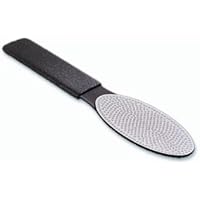


The #11 buffer is an outstanding tool. Used dry, you simple rub it across your feet. Dry skin quickly sheds off leaving a soft smooth surface. I follow the buffing with a good moisturizer and tuck my tootsies in socks. The results are smooth, soft pampered feet!
The price may seem high at first, but a pittance when you think of all the money you would have spent on pedicures.
The tool is designed to last for years and after use a quick wash with a small soft toothbrush and soap will have it ready for the next use.
An excellent value!
Click Here For Most Helpful Customer Reviews >>
After reading everyone's reviews I decided to take a leap of faith and order this product. I've been a long time sufferer of cracked / dry heels. I guess it is all the sandals and flip flops I wear. After the first use my heels felt as smooth as a babies bottom. Worth every penny in my opinion. I have never been so happy with a product. Truly a miracle. My husband thanks you as well :-) I also used Burts Bees Coconut Foot Creme, but didn't have to. My heels were incredibly soft just by buffing.Best Deals on Diamancel Tough Buffer #11
None of the reviews here at the time of my purchase really answered what I wanted to know. I'm reading about "rough heels" and thinking "I think I need something more powerful than something that makes one's heels smooth."Still, I was torn between this, the Diamancel #11 and the #20 callus device. The ball of my foot has a major callus that I've tussled with all my adult life. The #20 looked like it might be akin to a cheese shredder and I already have devices like thatthey do work, but leave your skins ripply and ripped up looking. Maybe #20 was not as unkind as that, but maybe the #11 would be quite enough.
For those who want to cut to the chase, yes, this baby was able to work on a serious callus in pretty short order. The UPS truck dropped it off and I literally sat right down and got to work with it. Honestly, 5 minutes later and both calluses (the other on the outside of the foot, below the pinkie toe) were about halfway gone. I can plainly see this works very quickly and will have these painful thick spots gone with a little more work, and leave my skin in much better shape.
If you have a ball of the foot callus, you might want to read on below for more thoughts, but if you just want to know if this buffer will work on a terminal stage callus, the answer is heck yeah.
-
The recurrent callus on the ball of my one foot is the result of a Morton's toe. Not to bore you, but when you walk, the pressure gets transferred forward from your heel up to your big toe. If that transfer doesn't happen correctly, you end up moving the pressure to the ball of the foot. The foot then responds by building up dead skin, and mine gets thick quickly. Left to its own devices, that callus would allow me to tap dance barefoot if it didn't hurt so much. Since the transfer is sending pressure away from the big toe and outwards, I've also developed a callus on the outside of the foot below the little toe, like a little tripod balance. Isn't nature wonderful?
I have a freaking collection of files, rollers with blades, a flatter thing with a Solingen steel blade in it, a PediEgg, a knockoff of a PediEgg, acid laced callus discs and so on. All have their merits and failings. Most of the stuff files your skin, or acts like a cheese shredder. For efficiency, the bladed items couldn't be beat. Yes, the blades have cut me a few times, but they have been the go-to tool to cut off thick skin quickly. Unfortunately the ball spot had gotten to the point where the skin was so smooth and hard that even the blades couldn't get ahold of anything, and slid right off. That's why I turned to this "buffer" which is an innocuous name for a file that works seriously well.
If you get calluses on the ball of your foot, you might have a Morton's toe too. A lot of places incorrectly say it's when your second toe (next to the big one) is longer than the big one, but this is wrong. It's an internal thing that has to do with bone lengths and is not always visble.
The ball of your foot hurts, so your instinct is to put padding where it hurts, as I did for a long time myself. The answer actually is to put the padding NEXT to the callous along the big toe down to the side of the ball of the foot. Then that part of your foot hits the ground before the ball and takes the pressure in the right path. I did this with thick moleskin and couldn't believe what a difference it made. The thing is, it's easy to get lazy about doing this, as the moleskin gets wet with daily showering, doesn't stick properly, and is unsightly. It's also expensive enough that you may not want to replace it daily. I think the answer for me might be to get a full foot length insole and cut away most of the toe area, leaving just the big toe area down to aside of the ball, and shift it from shoe to shoe.
Anyway, if that doesn't work well, no biggie, because this buffer is going to do a terrific job keeping the ball callus away. Best wishes to fellow sufferers!
[If any issues arise regarding the longevity of the buffer, I'll come back and edit.]
Honest reviews on Diamancel Tough Buffer #11
The foot file does a really good job but it's definitely over-priced. I am a nut about keeping my feet nice and wasted lots of money on files that did not get the job done. However, I have found files on the market for $5-$10 that do just as well as this one. The problem with those is that they do not last for more than a few months. So, I won't feel too bad about buying this one as long as it lasts the rest of my life. We shall see...Find helpful customer reviews and review ratings for Diamancel Tough Buffer #11
The Diamancel is costly, however,I believe you won't regret purchasing it. If you have a problem with dry cracked soles it will do wonders. I spent far more than that in creams and other products that just did not work. My feet are smooth and soft again which I can now maintain and don't have to be enbarassed anymore.

No comments:
Post a Comment